Search interest in mushroom chocolate bars has climbed steadily since 2023, and the shelf space at health food stores and online retailers backs that up. The global functional mushroom category was valued at roughly $34–38 billion in 2025, with some analysts projecting it could reach $80–85 billion by the mid-2030s as demand for natural cognitive, immune, and energy support keeps climbing.
If you’ve noticed these bars showing up at your local co-op, in wellness newsletters, or in your social feed, you’re not imagining a trend. But “mushroom chocolate bar” has become a confusing label, because it now covers everything from a lion’s mane dark chocolate square backed by peer-reviewed research to unregulated products that led to a multi-state hospitalization event in 2024.
This guide focuses specifically on functional mushroom chocolate — bars made with adaptogenic, non-psychoactive mushrooms like lion’s mane, reishi, cordyceps, and chaga. You’ll learn what’s actually inside these products, what the clinical research does and doesn’t support, how to read a label that’s worth trusting, and where the category’s real safety risks live.
What Exactly Is a Mushroom Chocolate Bar?
A functional mushroom chocolate bar is chocolate infused with extracts from medicinal mushroom species that have a long history in traditional medicine and a growing body of modern clinical research. The most common species are Lion’s Mane (Hericium erinaceus), Reishi (Ganoderma lucidum), Cordyceps (Cordyceps militaris or sinensis), and Chaga (Inonotus obliquus), often combined into multi-species blends.
These are not the same as raw culinary mushrooms like portobello or shiitake, and they’re chosen for compounds beyond basic nutrition — beta-glucan polysaccharides, triterpenes, and species-specific molecules like erinacines and hericenones in lion’s mane. The chocolate isn’t just a delivery vehicle either. Cacao itself contributes flavanols, theobromine, and mood-related compounds that researchers increasingly study alongside the mushroom extracts for potential synergistic effects.
It’s worth being precise about what this category is not. Functional mushroom bars are legally and chemically distinct from three other product types that also get called “mushroom chocolate”:
- Psilocybin (“magic mushroom”) chocolate, which contains a federally controlled psychoactive compound and is illegal to sell in most of the United States and most countries worldwide.
- Amanita muscaria chocolate, which contains muscimol, a psychoactive compound that is not FDA-approved as a food additive and has been linked to serious adverse events.
- Unregulated “mystery blend” edibles, sold with vague labeling and undisclosed ingredients, frequently through smoke shops or gray-market online retailers rather than established supplement brands.
Confusing these categories isn’t just a labeling technicality. It’s the difference between a dietary supplement regulated under the U.S. Dietary Supplement Health and Education Act (DSHEA) and a product that has, in documented cases, sent people to the emergency room. More on that distinction below.
Why the Category Is Booming Right Now
A few forces are converging to push functional mushroom chocolate from niche health-food-store item to mainstream wellness staple.
The science has matured. A decade ago, most of the evidence for medicinal mushrooms came from animal studies or small, uncontrolled trials. That’s changed. Randomized, placebo-controlled human trials on lion’s mane, reishi, and cordyceps have been published in peer-reviewed journals as recently as 2025, giving brands (and shoppers) something more concrete to point to than tradition alone.
Format matters more than ingredient novelty. Powders and capsules have existed for years, but chocolate solves two real adoption barriers: taste and habit-forming ease. Mushroom extracts, especially reishi and chaga, are bitter and earthy on their own. Chocolate masks that effectively while creating a format people already have a daily ritual around.
Manufacturing and testing have gotten more rigorous. Industry coverage from early 2026 points to a “boom-and-shakeout” dynamic: strong consumer demand is real, but rising ingredient costs and more sophisticated buyers are pushing weaker brands out. In response, credible manufacturers are standardizing beta-glucan content, publishing certificates of analysis (COAs), and investing in identity testing to confirm species. A new industry body, the Functional Mushroom Council, launched in early 2026 specifically to bring more quality oversight and consumer education to the space.
Consumers are more skeptical, not less. Because the category has attracted both genuinely rigorous brands and “too good to be true” listings, today’s buyer is more likely to ask for lab reports and species names before purchasing than they were even two years ago. That skepticism is a healthy sign for a supplement category this young.
The Mushrooms Inside the Bar: What the Research Actually Shows
Different mushroom species are chosen for different jobs. Here’s what peer-reviewed human research currently supports for the four species that dominate the category, along with honest caveats about the state of the evidence.
Lion’s Mane: cognition and mood
Lion’s Mane is the species most associated with cognitive support, largely because of two bioactive compound families: hericenones (concentrated in the fruiting body) and erinacines (concentrated in the mycelium), both of which have been studied for their potential to stimulate nerve growth factor (NGF) production.
A 2023 double-blind, placebo-controlled pilot study in healthy young adults found that a single 1.8 g dose of Hericium erinaceus improved reaction speed on a Stroop cognitive task within 60 minutes, with a trend toward reduced subjective stress after 28 days of continued use. A 2025 follow-up study published in Frontiers in Nutrition, also double-blind and placebo-controlled, examined acute cognitive and mood effects of a standardized extract in healthy younger adults.
Older adult research tells a more mixed story. A double-blind trial in 49 patients with mild Alzheimer’s disease found that 49 weeks of lion’s mane mycelium supplementation significantly improved instrumental activities of daily living scores, but did not produce measurable improvement on standard cognitive screening tools like the MMSE. Researchers reviewing the broader literature in 2025 have consistently flagged the same limitation: most trials are small, use different extraction methods and doses, and no standardized clinical protocol yet exists.
Bottom line: the mechanistic and early clinical evidence for lion’s mane is genuinely promising, particularly for mood and processing speed, but it remains an emerging research area rather than a settled one.
Reishi: immune modulation
Reishi has the deepest clinical evidence base of the four species, primarily around immune function. A randomized, double-blind, placebo-controlled trial in healthy adults aged 18–55 found that 84 days of Reishi beta-glucan supplementation (standardized to roughly 75% beta-glucan content) produced significant increases in CD3+, CD4+, and CD8+ T-lymphocyte populations, an improved CD4/CD8 ratio, and higher natural killer cell counts compared to placebo.
A separate randomized trial in children aged 3 to 5 found that Reishi beta-glucan delivered through fortified yogurt significantly increased circulating T-lymphocyte counts over 12 weeks, with high treatment adherence and no abnormal changes in liver or kidney safety markers. Mechanistically, researchers have traced these effects to beta-glucan’s interaction with immune receptors like dectin-1 and Toll-like receptors, which triggers downstream immune cell signaling.
Bottom line: of the four species covered here, reishi’s immune-modulation evidence is the most consistent across independent trials and age groups, though evidence for other traditional claims — sleep, cancer-adjunct use, cardiovascular support — remains earlier-stage.
Cordyceps: energy and exercise performance
Cordyceps is marketed almost universally around energy, stamina, and athletic performance, and this is one of the better-studied use cases in the category. Multiple randomized, placebo-controlled human trials have measured VO2 max, the standard marker of aerobic capacity.
A widely cited trial in older adults using fermented Cordyceps sinensis (Cs-4, 3 g/day) for six weeks found a statistically significant improvement in VO2 max alongside improved anaerobic threshold. A separate trial in younger, trained adults found a roughly 10.9% VO2 max improvement after three weeks of Cordyceps militaris supplementation, with no change in the placebo group, along with improved time-to-exhaustion at both one and three weeks. Proposed mechanisms include enhanced mitochondrial ATP production and mild vasodilation that improves oxygen delivery to working muscle.
Not every study agrees. A review of exercise trials noted that several earlier studies found no measurable performance benefit from cordyceps supplementation, and researchers describe the overall evidence base as still “limited and inconclusive” despite the more encouraging recent trials. As with lion’s mane, effects appear to require several weeks of consistent use rather than showing up after a single dose.
Bottom line: cordyceps has some of the more mechanistically plausible and repeatedly tested performance evidence in the functional mushroom space, but results are inconsistent across studies and species/strain matters.
Chaga: antioxidant capacity
Chaga is included in blends primarily for its exceptionally high antioxidant capacity, driven by a dense concentration of phenolic compounds, melanin complexes, and triterpenes. Independent lab testing using the ORAC (oxygen radical absorbance capacity) method has found chaga’s antioxidant capacity to be dramatically higher than many other antioxidant-rich foods, including several multiples higher than dark chocolate itself.
What makes chaga particularly relevant to this specific product category is a 2025 academic review examining the potential “food synergy” between chaga and cocoa. The review notes that both ingredients share overlapping bioactive compound classes — triterpenoids and flavanols — and proposes that combining them in a single product could theoretically amplify antioxidant and anti-inflammatory effects beyond what either ingredient delivers alone, though the authors are clear that a structured clinical model testing this specific combination doesn’t yet exist. Most chaga research to date is preclinical (cell and animal studies) rather than large human trials, so claims should be read as promising rather than proven.
Bottom line: chaga’s antioxidant capacity in lab assays is well documented; its combination with cacao is scientifically plausible but still an open research question rather than a settled clinical finding.
Fruiting Body vs. Mycelium: The Detail That Determines Whether a Bar Actually Works
This is the single most important quality signal in the entire category, and it’s the one most shoppers skip.
Mushrooms used in supplements come from one of two parts of the organism: the fruiting body (the visible cap and stem — what most people picture as “a mushroom”) or the mycelium (the root-like network that grows through a substrate, often grain, before harvest). These two materials are not nutritionally interchangeable.
Fruiting body extracts typically contain 25–40% beta-glucans when properly processed, while mycelium grown on grain substrate often measures only 1–5% beta-glucan, with the remainder largely composed of starch from the grain it was grown on. A peer-reviewed method published in the Journal of AOAC International, developed specifically to standardize beta-glucan measurement across commercial mushroom products, documented this gap clearly. Because FDA labeling rules require disclosure of “mycelium” versus “fruiting body” but don’t restrict the practice itself, some lower-quality products are effectively selling starch-diluted grain powder under the mushroom’s name.
There are exceptions worth knowing. Lion’s Mane is a genuine special case: hericenones concentrate in the fruiting body, but erinacines — the compounds most associated with nerve growth factor stimulation — are concentrated in the mycelium. For that specific species, a dual-source or dual-extraction product may deliver a broader compound profile than a fruiting-body-only extract.
Dual extraction (using both hot water and alcohol/ethanol) is another marker of manufacturing quality. Hot water extraction pulls water-soluble beta-glucans; alcohol extraction captures fat-soluble compounds like triterpenes that water alone won’t dissolve. A bar or extract that specifies “dual-extracted” is signaling a more complete extraction process than a simple hot-water tea or raw powder.
Why Chocolate Became the Delivery Format of Choice
Chocolate isn’t an arbitrary packaging choice. It solves the two biggest practical problems with medicinal mushroom extracts: flavor and dosing consistency.
Raw reishi and chaga extracts are intensely bitter, and even lion’s mane and cordyceps carry an earthy aftertaste that many first-time users find off-putting in capsules or raw powders. Chocolate’s fat content and sweetness mask these flavors far more effectively than gummies or drink mixes, which is part of why flavor-forward formats (chai, mocha, mint) have become a defined 2026 trend within the category as brands compete on palatability rather than novelty alone.
Chocolate also solves dosing. Quality bars are typically scored into individual squares, each corresponding to a stated milligram amount of mushroom extract, which makes it straightforward to take a consistent, repeatable dose daily — something that’s harder to standardize with loose powders. And cacao isn’t a neutral carrier ingredient. It independently contributes flavanols associated with vascular and mood benefits, along with modest amounts of theobromine, a mild stimulant compound that some formulators pair intentionally with cordyceps for an energy-focused product.
Safety First: What the 2024 Recall Taught the Industry
No honest guide to this category can skip what happened with Diamond Shruumz in 2024, because it’s the clearest real-world illustration of why label transparency matters.
In June 2024, the FDA and CDC opened a joint investigation after a wave of severe illnesses linked to Diamond Shruumz-brand chocolate bars, cones, and gummies, which were marketed using language like “microdosing” and “functional mushrooms” alongside claims that the products contained no psychoactive or scheduled substances. By the time the investigation closed, CDC had confirmed 180 illnesses across 34 states, including 73 hospitalizations and three potentially associated deaths. Reported symptoms included seizures, loss of consciousness, abnormal heart rate, and respiratory failure serious enough to require intubation in some patients.
FDA laboratory testing later found that the products contained muscimol — a compound found in Amanita muscaria mushrooms that is not approved as a food additive — along with, in some tested samples, psilacetin (a psilocybin analog sometimes called “synthetic shrooms”) and kava-derived compounds, none of which were disclosed on the label. The company’s own marketing had explicitly claimed the products contained no psilocybin, no Amanita, and “no scheduled drugs.”
This episode matters for functional mushroom chocolate specifically because the affected products were marketed using the exact same vocabulary — “functional mushrooms,” “adaptogens,” “nootropics,” “microdosing” — that legitimate lion’s mane and reishi brands use honestly. CDC’s own health advisory noted this overlap directly, warning clinicians to have a “high index of suspicion” for any patient presenting with symptoms after consuming a mushroom-labeled edible, precisely because the marketing language alone can’t distinguish a safe product from a dangerous one.
The practical takeaway isn’t that functional mushroom chocolate is unsafe. Lion’s Mane, Reishi, Cordyceps, and Chaga have extensive safety data and are, per DSHEA, legal dietary supplements. The takeaway is that marketing claims are not proof, and the only reliable way to distinguish a legitimate functional mushroom bar from a mislabeled or adulterated one is to verify what’s actually documented on the Supplement Facts panel and in third-party lab testing.
How to Read a Mushroom Chocolate Bar Label Like a Pro
Use this checklist before buying, whether you’re shopping online or in a store:
- Named species with Latin binomials. A trustworthy label says “Hericium erinaceus” or “Lion’s Mane (Hericium erinaceus),” not just “proprietary mushroom blend.” Vague blend names with no species disclosed are the single biggest red flag in the category.
- Part used. The label should state fruiting body, mycelium, or both. If this is absent entirely, assume the product may be low in active compounds.
- Beta-glucan percentage. Reputable brands disclose standardized beta-glucan content (commonly 25%+ for fruiting body extracts). Absence of this number usually means it hasn’t been tested or the brand doesn’t want to disclose a low result.
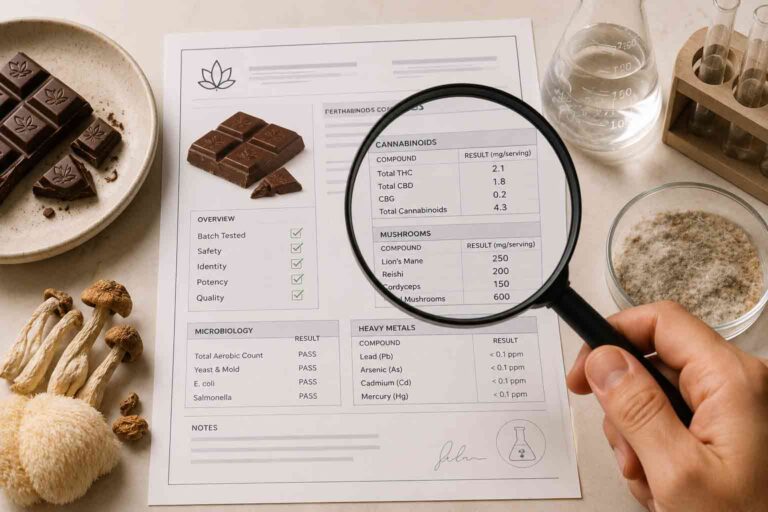
- Third-party Certificate of Analysis (COA). Look for a lab report confirming potency and screening for heavy metals, pesticides, and microbial contamination, since mushrooms can bioaccumulate environmental contaminants from their growing substrate.
- DSHEA supplement disclaimer. Legitimate functional mushroom products carry the standard FDA dietary supplement disclaimer (“This statement has not been evaluated by the FDA…”) because they’re regulated as supplements, not drugs.
- No psychoactive-adjacent claims. Words like “trip,” “journey,” “euphoria,” or unexplained “microdosing” language on a product that also lists Lion’s Mane or Reishi should raise questions about what else might be in the formula.
- Manufacturing transparency. GMP-certified, FDA-registered facility information is a meaningful trust signal that’s cheap for a legitimate brand to disclose and hard for a low-quality operation to fake convincingly.
Who Might Benefit — and Who Should Talk to a Doctor First
Functional mushrooms are generally well tolerated in healthy adults at studied doses, but “generally well tolerated” isn’t the same as “appropriate for everyone.” A few groups should check with a healthcare provider before adding mushroom chocolate to a routine:
- Anyone on immunosuppressant medication or with an autoimmune condition, since reishi and other beta-glucan-rich mushrooms are immune-modulating and could theoretically interact with drugs designed to suppress immune activity.
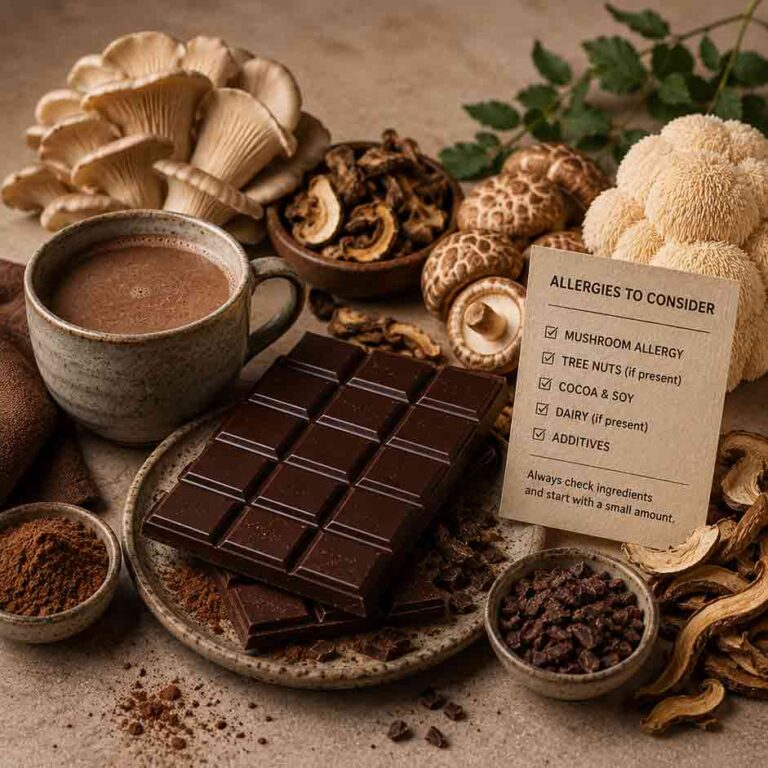
- Anyone with a diagnosed mushroom or fungal allergy.
- Pregnant or breastfeeding individuals, since most clinical trials specifically exclude this population, meaning safety data is limited rather than reassuring.
- Anyone taking blood thinners or medications metabolized by the liver, given some preclinical evidence of mushroom compounds affecting coagulation and liver enzyme pathways.
- Anyone currently on prescription medication generally, simply because supplement-drug interaction research for these species is still thin compared to pharmaceutical-grade interaction studies.
None of this means functional mushroom chocolate is risky for the average healthy adult. It means the honest, trustworthy version of this content — the kind Google and AI search systems increasingly reward — treats “check with your doctor” as a real recommendation rather than legal boilerplate.
The Bottom Line
Functional mushroom chocolate bars sit at a genuinely interesting intersection: real, maturing clinical research on species like Lion’s Mane, Reishi, Cordyceps, and Chaga, combined with a format — chocolate — that solves the taste and dosing problems that have limited medicinal mushroom adoption for years. The science isn’t settled or dramatic; effects documented in trials are measurable but modest, and most require weeks of consistent use rather than a single dose.
What separates a good product from a risky one in this category isn’t the marketing copy. It’s whether the brand names its species in Latin, discloses fruiting body versus mycelium, publishes a beta-glucan percentage, and backs all of it with third-party lab testing. The 2024 Diamond Shruumz recall exists as a permanent reminder of what happens when that transparency is missing. If you’re considering a mushroom chocolate bar, start with the label, not the packaging, and don’t hesitate to ask a brand directly for its COA before you buy.
Frequently Asked Questions
Are mushroom chocolate bars psychoactive?
Functional mushroom chocolate bars made with Lion’s Mane, Reishi, Cordyceps, or Chaga are not intended to be psychoactive and don’t contain psilocybin. Products marketed with language like “trip,” “journey,” or unexplained “microdosing” may contain undisclosed psychoactive compounds and belong to a legally distinct category.
Are functional mushroom chocolate bars legal?
Yes. In the United States, chocolate made with non-psychoactive functional mushrooms like Lion’s Mane, Reishi, Cordyceps, and Chaga is legal and regulated as a dietary supplement under DSHEA, provided it complies with food safety and labeling rules.
Do mushroom chocolate bars actually work?
Peer-reviewed human trials support modest, measurable effects for some species — reishi for immune cell counts, cordyceps for VO2 max and exercise capacity, lion’s mane for processing speed and mood. Evidence is real but early-stage, and effects generally build over weeks of consistent use rather than appearing after one bar.
What’s the difference between fruiting body and mycelium?
The fruiting body is the visible mushroom cap and stem; mycelium is the root-like network often grown on grain substrate. Fruiting body extracts typically contain far higher beta-glucan concentrations (25–40%) than mycelium-on-grain products (1–5%), making the fruiting body generally the more potent source for most species.
Is it safe to eat mushroom chocolate every day?
For healthy adults, daily use at labeled serving sizes is how most clinical trials were structured, and the species covered here have solid safety records at those doses. People who are pregnant, immunosuppressed, or on prescription medication should talk to a doctor first, since drug-interaction research for these species remains limited.
How is this different from the products in the 2024 FDA recall?
The 2024 Diamond Shruumz recall involved products that used functional-mushroom marketing language but were later found by FDA testing to contain undisclosed muscimol, psilacetin, and kava-derived compounds not listed on the label. Legitimate functional mushroom brands disclose species, part used, beta-glucan content, and third-party lab results — none of which were present or accurate on the recalled products.
Sources
- Surendran, G., et al. “Acute effects of a standardised extract of Hericium erinaceus on cognition and mood in healthy younger adults.” Frontiers in Nutrition, 2025. DOI: 10.3389/fnut.2025.1405796 — https://www.frontiersin.org/journals/nutrition/articles/10.3389/fnut.2025.1405796/full
- Docherty, S., Doughty, F.L., Smith, E.F. “The Acute and Chronic Effects of Lion’s Mane Mushroom Supplementation on Cognitive Function, Stress and Mood in Young Adults.” Nutrients, 2023. DOI: 10.3390/nu15224842 — https://pmc.ncbi.nlm.nih.gov/articles/PMC10675414/
- Li, I., et al. “Prevention of Early Alzheimer’s Disease by Erinacine A-Enriched Hericium erinaceus Mycelia.” Frontiers in Aging Neuroscience, 2020. DOI: 10.3389/fnagi.2020.00155 — https://doi.org/10.3389/fnagi.2020.00155
- “Evaluation of Immune Modulation by β-1,3;1,6 D-Glucan Derived from Ganoderma lucidum in Healthy Adult Volunteers, A Randomized Controlled Trial.” PMC9914031. https://pmc.ncbi.nlm.nih.gov/articles/PMC9914031/
- “Randomized Clinical Trial for the Evaluation of Immune Modulation by Yogurt Enriched with β-Glucans from Ganoderma lucidum in Children.” PubMed 30317947. https://pubmed.ncbi.nlm.nih.gov/30317947/
- “Effect of Cs-4® (Cordyceps sinensis) on Exercise Performance in Healthy Older Subjects: A Double-Blind, Placebo-Controlled Trial.” PMC3110835. https://pmc.ncbi.nlm.nih.gov/articles/PMC3110835/
- “Cordyceps militaris improves tolerance to high intensity exercise after acute and chronic supplementation.” PMC5236007. https://pmc.ncbi.nlm.nih.gov/articles/PMC5236007/
- “A Review: Food Synergy Effect between Chaga Mushroom and Chocolate — with Product Development Prototype.” Cornell eCommons, 2025. https://ecommons.cornell.edu/items/eebe5c93-25ff-4b2b-b327-325d899f9d0e
- FDA. “Investigation of Illnesses: Diamond Shruumz-Brand Chocolate Bars, Cones, & Gummies.” fda.gov, 2024. https://www.fda.gov/food/outbreaks-foodborne-illness/investigation-illnesses-diamond-shruumz-brand-chocolate-bars-cones-gummies-june-2024
- CDC. “Severe Illness Potentially Associated with Consuming Diamond Shruumz Brand Chocolate Bars, Cones, and Gummies.” cdc.gov, 2024. https://www.cdc.gov/environmental-health-studies/outbreak-investigation-diamond-shruumz-products/index.html
- CDC. “Health Alert Network (HAN) – 00509.” cdc.gov, 2024. https://www.cdc.gov/han/2024/han00509.html
- Journal of AOAC International — standardized beta-glucan measurement method across commercial fruiting body vs. mycelium-on-grain mushroom products, as cited in: “Fruiting Body vs. Mycelium: Why It Matters in Mushroom Gummies.” Cornbread Hemp. https://www.cornbreadhemp.com/blogs/learn/fruiting-body-vs-mycelium-mushroom-gummies