Key Takeaways (TL;DR)
-
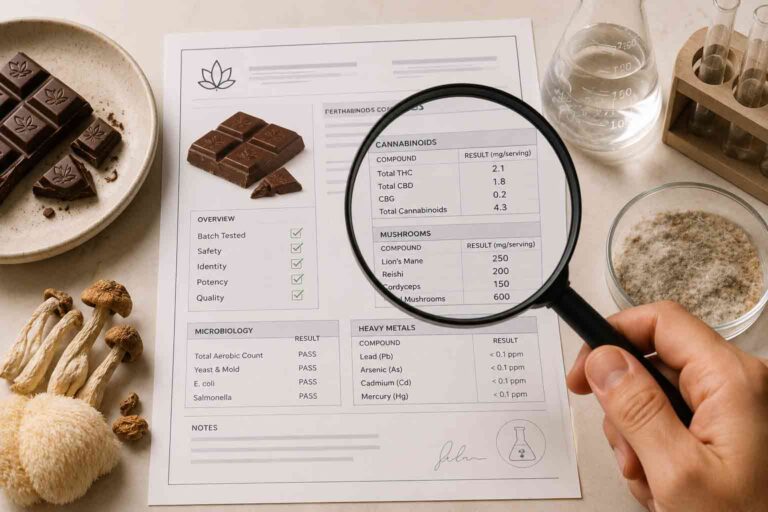
Standard lab Certificates of Analysis (COAs) check potency, heavy metals, pesticides, microbiology, and mycotoxins — but not every product gets all five panels.
-
Tests can confirm what a compound is, but often cannot catch unlisted synthetic adulterants unless labs specifically screen for them.
-
The Diamond Shruumz outbreak (2024) — 180 hospitalizations, 73 cases, 3 deaths across 34 US states — happened partly because labs were not equipped to test for the specific toxic compounds present.
-
Functional mushroom chocolates face a separate fraud problem: mycelium-on-grain products can legally pass all safety tests while delivering negligible amounts of the beta-glucans that provide health benefits.
-
A COA from a reputable, ISO 17025-accredited lab is necessary but not sufficient. Knowing which panels were run — and which were skipped — is what actually tells you whether a product is safe and effective.
Why This Question Matters Right Now
In June 2024, a 20-something couple in Yavapai County, Arizona, split a Diamond Shruumz chocolate bar. Both ended up in the hospital. That case became the starting point of a national outbreak investigation that eventually identified 180 cases across 34 states — including three suspected deaths — all tied to mushroom-branded edible products.
What made the Diamond Shruumz crisis particularly alarming wasn’t just the scale. It was what it revealed about testing infrastructure. As Roy Gerona, a toxicology researcher at the University of California, San Francisco who worked with the Drug Enforcement Administration on the investigation, told NPR: “Most labs were not ready to test for this mushroom.” Even his own lab, which specializes in detecting designer drugs, had to rush to develop accurate tests for the compounds in question. Gerona was candid about the gaps: “I think some of us are asking ourselves, what are we missing here?”
That question — what are we missing? — is exactly what consumers, brands, and regulators should be asking every time they look at a Certificate of Analysis for a mushroom chocolate product.
This guide breaks down what standard lab testing actually covers, where the structural blind spots are, and what questions to ask before trusting any COA.
The Two Categories of Mushroom Chocolate (and Why the Testing Differs)
Before unpacking what labs test for, it helps to understand that “mushroom chocolate” is not a single product category. It covers at least two very different things with very different regulatory situations and very different safety risks.
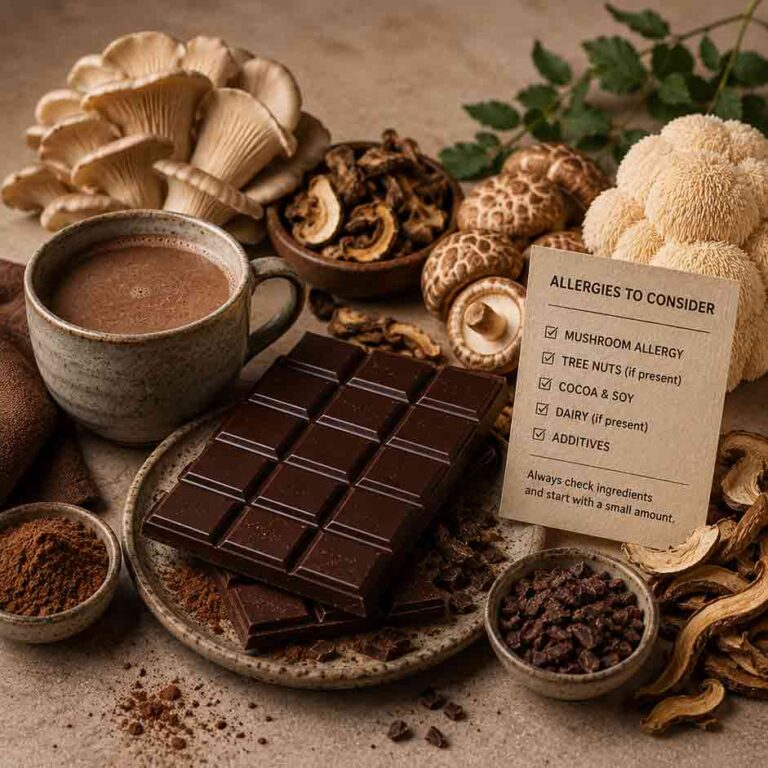
Functional mushroom chocolates contain species like lion’s mane (Hericium erinaceus), reishi (Ganoderma lucidum), cordyceps (Cordyceps militaris), chaga (Inonotus obliquus), or turkey tail (Trametes versicolor). These are legal across the United States, sold as dietary supplements, and broadly regulated under DSHEA (the Dietary Supplement Health and Education Act). Their primary safety concern isn’t acute toxicity — it’s efficacy fraud: products that pass every safety test but contain so little of the actual mushroom compound that they can’t deliver the benefits they advertise.
Psychedelic mushroom chocolates are a far more complex legal landscape. As of 2026, Oregon’s Psilocybin Services program (operating under Measure 109) and Colorado’s Natural Medicine Health Act (Proposition 122) are the only state-level frameworks with mandatory testing requirements for psilocybin-containing products. Oregon requires licensed laboratories accredited by the Oregon Environmental Laboratory Accreditation Program (ORELAP) to test all products for psilocybin, psilocin, baeocystin, and norbaeocystin potency; heavy metals; pesticide residues; and microbiology. Colorado issued its first licenses for licensed healing centers in March 2025. Outside those frameworks, unregulated products marketed with implied psychedelic or psychoactive effects exist in a gray zone with minimal testing oversight.
The 2024 Diamond Shruumz case involved products in that gray zone — marketed as containing “proprietary blends of mushroom extracts and adaptogens,” sold at retail shops and online nationwide, with no standardized testing requirement.
What Standard Lab Testing Actually Checks
1. Potency Testing
Potency testing answers the question: is the amount of active compound on the label accurate?
For functional mushrooms, the key marker is beta-glucan content — the immune-modulating polysaccharides concentrated in the fruiting body of species like reishi, lion’s mane, and turkey tail. According to the methodology established by the Megazyme beta-glucan assay (the industry reference standard), quality fruiting body extracts should contain between 25% and 40% beta-glucans by weight. The measurement is critical because it’s also what distinguishes a real mushroom extract from a mycelium-on-grain product — an issue explored in depth later in this article.
For functional mushrooms, additional potency markers include:
- Triterpenes (particularly ganoderic acids in reishi)
- Hericenones and erinacines in lion’s mane
- Cordycepin and adenosine in cordyceps
- Ergothioneine across multiple species
For regulated psilocybin products in Oregon and Colorado, potency panels must quantify psilocybin, psilocin, baeocystin, and norbaeocystin — the four primary alkaloids. Researchers at the University of Texas at Arlington published a validated LC-MS/MS method for psilocybin and psilocin quantification in Psilocybe cubensis in Analytica Chimica Acta (Goff et al., 2024) that provides high accuracy for targeted quantitation. High-resolution mass spectrometry (LC-HRMS) additionally enables untargeted profiling that can catch aeruginascin, norpsilocin, and other minor compounds alongside the primary targets.
One technical note that matters: GC-MS (gas chromatography-mass spectrometry) cannot independently quantify psilocybin and psilocin from a single underivatized analysis. Labs using HPLC (high-performance liquid chromatography) or LC-MS/MS for these compounds produce more reliable results. If a COA for a psilocybin-containing product cites only GC-MS methodology for quantitation, that’s a flag worth raising with the testing lab.
2. Heavy Metals Screening
Mushrooms are hyperaccumulators — they absorb and concentrate compounds from their growing substrate, soil, and water at rates significantly higher than most plants. This makes heavy metals screening non-negotiable for any mushroom product.
Standard heavy metals panels test for four primary elements:
- Lead (Pb)
- Arsenic (As)
- Cadmium (Cd)
- Mercury (Hg)
Acceptable limits are set by the United States Pharmacopeia (USP) and FDA guidelines. A reputable COA should show actual parts-per-million (ppm) values for each element — not just a binary “pass” notation — so consumers can compare results against the specific thresholds. If a COA reports only “ND” (non-detect) for all four metals without showing the method detection limit, it’s not possible to evaluate whether the detection limit was sensitive enough to catch low-level contamination.
Non-organic mushroom cultivation is where heavy metals risk is highest. Substrate quality, water source, and air quality in grow facilities all influence the final metal load in the fruiting body or mycelial material.
3. Pesticide Screening
Pesticide screening is a multi-residue test designed to detect the presence of agricultural chemicals that may have been applied during cultivation or introduced through the growing substrate.
Standard pesticide panels screen for organophosphates, carbamates, pyrethroids, and fungicides — often covering several hundred individual compounds simultaneously using LC-MS/MS. European organic certification standards require testing for several hundred prohibited pesticides, a more stringent bar than most US-market requirements.
For organic-certified products, pesticide results should show no detectable residues. For non-certified products, results should be compared against FDA tolerance levels.
4. Microbiology Panels
Microbiology testing screens for harmful bacteria, yeast, and mold to confirm a product is safe for consumption and was manufactured under appropriate sanitary conditions.
Core microbiology tests include:
- Total aerobic plate count (APC) — overall bacterial load
- Escherichia coli (E. coli) — specifically, the absence of pathogenic strains
- Salmonella — presence/absence
- Yeast and mold count
For chocolate-based products specifically, the manufacturing environment introduces additional contamination risk because chocolate production facilities handle ingredients at temperatures that can support microbial growth if not properly managed.
5. Mycotoxin Testing
Mycotoxins are toxic secondary metabolites produced by molds — including aflatoxins, ochratoxin A, fumonisins, and others. They can form on mushroom material during improper storage or cultivation, and they represent a meaningful health risk even at low concentrations.
ACS Laboratory, one of the major accredited testing facilities serving the mushroom supplement market, uses medical-grade equipment to detect mycotoxins at trace amounts. Aflatoxin B1 is the most closely watched, as it’s both highly toxic and a known carcinogen.
What Standard Lab Testing Can Miss
This is where the conversation gets more important — and where the 2024 outbreak cases become directly instructive.
Synthetic Adulterants (Unless Specifically Screened For)
The federal investigation into Diamond Shruumz found 4-AcO-DMT (a synthetic version of psilocybin, also called psilacetin) in the products. It also found pregabalin — an anticonvulsant drug sold under the brand name Lyrica — and the herbal supplement kava.
None of these compounds would appear on a standard functional mushroom safety panel. A lab testing for heavy metals, pesticides, microbiology, and mycotoxins would return a clean COA on a product that also contained pregabalin — because pregabalin isn’t on the standard panel.
Roy Gerona’s toxicology lab noted the fundamental challenge: “Analyzing something like a chocolate bar is no easy task — and it’s especially difficult to detect muscimol and ibotenic acid, two of the potentially toxic compounds.” Even the FDA, which confirmed muscimol in some Diamond Shruumz products, noted that not all of the current findings adequately explained the illnesses. Some labs were still developing accurate tests for Amanita muscaria compounds at the time of the outbreak.
This is the core structural gap in mushroom chocolate testing: labs test for what they’re set up to test for. A targeted panel looking for psilocybin won’t catch 4-AcO-DMT unless the panel explicitly includes it. A standard safety panel won’t catch pharmaceutical adulterants unless someone adds pharmaceutical screening. Tryptomics, a specialized testing laboratory, offers a dedicated panel designed to “detect synthetic tryptamines like 4-AcO-DMT and other non-natural compounds” — but this is a specialized add-on, not a standard panel included in most COAs.
Species Identity Fraud
Standard chemical testing confirms what compounds are present. It doesn’t always confirm which species those compounds came from.
DNA-based species authentication is a separate test — offered by services like Leafworks, which performs species identification using advanced molecular techniques and validated species-specific markers. A COA from a potency-focused lab confirms you have, say, 30% beta-glucans. It doesn’t necessarily confirm those beta-glucans came from lion’s mane rather than a cheaper species or a blend of undisclosed materials.
A 2024 study by Alkemist Labs found that 30% of botanicals and fungi tested during the first half of the year were flagged during identity testing — including lion’s mane, lemon balm, ashwagandha, and rhodiola. The company, which conducts HPTLC (high-performance thin-layer chromatography) identity testing, identified lion’s mane as one of the top 20 ingredients most likely to be adulterated or contaminated in the supplement market.
The Mycelium-on-Grain Problem (the Legal Fraud That COAs Don’t Catch)
This is the most widespread quality problem in functional mushroom chocolates and supplements — and it’s one that a COA can entirely miss, depending on what’s being measured.
Here’s the core issue: many manufacturers grow mycelium (the root-like structure of fungi) on grain substrates — typically rice or oats. Once the mycelium colonizes the grain, the two cannot be separated. The resulting product is dried, ground into powder, and sold as “mushroom supplement.” In many cases, the grain starch significantly outweighs the actual fungal material. According to research published in Mycobiology and reviewed by Nammex (a major supplier of mushroom extracts), mycelium-on-grain products typically contain only 1–5% beta-glucans, compared with 25–40% in proper fruiting body extracts. Some analyses have found mycelium-on-grain powders with 35–40% starch — essentially tracking the nutritional content of the grain itself.
The problem is that total polysaccharide tests — which some companies use on their COAs — will show an impressive number, because both mushroom beta-glucans and grain starch are polysaccharides. A product with 40% polysaccharides could be primarily grain starch delivering almost no functional mushroom compound.
The test that catches this distinction is alpha-glucan content testing. Alpha-glucans are the polysaccharides found in grain starch. A COA that measures both beta-glucans and alpha-glucans separately reveals the ratio — and a high alpha-glucan reading is the clearest indicator of significant grain filler.
As Justin Hartfield, founder of ShrooMap (a mushroom supplement review platform), put it in a 2026 TheStreet interview: “We’ve tested products that list ‘Lion’s Mane extract’ on the label but are mostly mycelium grown on grain — essentially rice filler with trace amounts of the actual mushroom.”
The FDA has labeling guidelines that require disclosure when mycelium is used, but enforcement is widely acknowledged to be lax. A product labeled “mushroom complex” or “full spectrum mushroom” is not required to specify whether it comes from fruiting bodies or myceliated grain — making beta-glucan percentage on the COA (not just polysaccharide percentage) the most actionable data point for consumers.
Homogeneity and Dosing Consistency
Lab testing is performed on a representative sample — typically a small portion of a batch. For chocolate products, this creates a meaningful gap: the distribution of active compounds within a chocolate bar may not be uniform. A square from the edge of a bar may have a different potency profile than a square from the center, depending on how the mushroom extract or mushroom material was incorporated into the chocolate matrix.
Oregon’s testing framework for psilocybin products mandates batch testing for every five pounds of whole mushroom material, a stricter threshold than cannabis testing requirements in most states (which typically require testing every fifteen pounds). But for unregulated products in most of the country, no such frequency requirement exists.
How to Read a Mushroom Chocolate COA: A Practical Framework
A COA should answer at least five questions. If it can’t answer all five, that’s a gap worth noting.
1. Which panels were actually run? The COA should list the specific tests conducted. “Third-party tested” on packaging tells you nothing about what was tested. A full safety panel includes potency, heavy metals (with actual ppm values), pesticides, microbiology, and mycotoxins. Anything fewer deserves a direct question to the brand.
2. What is the beta-glucan percentage — not just polysaccharides? For functional mushroom products, the beta-glucan percentage using a validated assay (the Megazyme method is the industry standard) is the key potency indicator. A target of 20% or above from a fruiting body extract is a reliable quality marker. If only “polysaccharides” are listed, ask the brand for the specific beta-glucan percentage.
3. Is the testing laboratory ISO 17025 accredited? ISO 17025 is the international benchmark for testing and calibration laboratory competence. Labs holding this accreditation demonstrate validated methods, calibrated equipment, and independent quality oversight. Consumers can verify accreditation status directly by contacting the laboratory or checking national accreditation body databases.
4. Is the COA batch-specific? A COA should include a lot number or batch number that matches the product you’re evaluating. A generic COA without a batch-specific ID may reflect testing of a different production run. Reputable brands publish batch-specific COAs accessible via QR code on packaging or a publicly searchable portal.
5. How old is it? A COA that’s more than twelve months old may not reflect the current production batch. Ingredient sources, substrate quality, and formulations change. Premium brands test every production batch.
The Regulatory Landscape in 2026
The testing framework for mushroom chocolates varies dramatically by product type and geography.
Oregon’s framework is the most developed state-level psilocybin quality control system in the US. Required tests include psilocybin, psilocin, baeocystin, and norbaeocystin potency; heavy metals; pesticide residues; and microbiological safety parameters. All testing must be performed by ORELAP-accredited labs.
Colorado’s framework under the Natural Medicine Health Act similarly requires testing of natural medicine products, with oversight from the Department of Regulatory Agencies (DORA). The program issued its first healing center licenses in March 2025.
For functional mushroom supplements — whether in chocolate, capsule, gummy, or powder form — there is no federal pre-approval requirement. Under DSHEA, supplement manufacturers are responsible for ensuring their products are safe before selling them, but FDA does not review or approve supplements before they reach market. Beta-glucan disclosure is voluntary. Species identity verification is not required. Third-party testing is not mandated, though it is strongly recommended by consumer advocates and regulators.
The California Department of Public Health (CDPH) issued a 2025 warning specifically about TRE House brand mushroom chocolate bars and gummies that were laboratory tested and found to be adulterated. California’s response to the Diamond Shruumz outbreak included targeted enforcement actions — but the underlying federal regulatory gap that allowed the products to reach market remained in place.
What This Means If You’re Buying or Selling Mushroom Chocolate
For consumers:
A COA is a starting point, not an endpoint. Before trusting one, identify which panels it covers, confirm the lab’s accreditation status, and verify the batch number matches your product. For functional mushroom products, demand a beta-glucan percentage — not just total polysaccharides. For any product that claims psychoactive effects, additional scrutiny is warranted, particularly given the 2024 outbreak evidence that unregulated products in this space have contained undisclosed pharmaceutical compounds.
The CDC’s Health Alert Network advisory from June 2024 stated clearly: “edibles or food-like products marketed with nonspecific health benefits or implied psychoactive effects might contain undisclosed, misformulated, or unapproved ingredients that can cause severe adverse health effects.”
For brands:
The minimum responsible testing stack for a functional mushroom chocolate includes potency (with specific beta-glucan quantification using the Megazyme method), heavy metals with reported ppm values, pesticide screening, microbiology, and mycotoxins. For any product with implied psychoactive effects, that baseline needs to expand to include targeted screening for synthetic tryptamines, pharmaceutical compounds, and species-specific testing for Amanita muscaria compounds including muscimol and ibotenic acid — given that standard panels will not catch these unless specifically configured to do so.
Batch-specific, publicly accessible COAs from ISO 17025-accredited labs, with lot numbers linked to QR codes on packaging, represent the current quality standard. Anything below that is a credibility and liability gap.
Frequently Asked Questions
Does a Certificate of Analysis guarantee a mushroom chocolate is safe?
No. A COA reports results for the tests that were run. If a product contains a synthetic adulterant that wasn’t included in the test panel, the COA will not detect it. The Diamond Shruumz outbreak demonstrated this directly: products were widely available and sold without detecting the compounds that ultimately caused illness, because most labs didn’t include them in standard panels at the time.
What is the difference between beta-glucans and polysaccharides on a COA?
Polysaccharides is a broad category that includes all complex carbohydrates — both the beneficial beta-glucans found in mushroom fruiting bodies and the alpha-glucans (starch) found in grain. A high polysaccharide percentage without a specific beta-glucan percentage can indicate the product is primarily grain filler, not mushroom. Always ask for the beta-glucan percentage specifically.
What is 4-AcO-DMT and why does it matter for lab testing?
4-AcO-DMT (psilacetin) is a synthetic analogue of psilocybin. It is not a scheduled controlled substance but may be considered illegal under federal law due to its similarity to psilocybin. It was found by federal investigators in Diamond Shruumz products. Most standard safety panels do not test for it unless specifically configured to do so. Labs like Tryptomics offer specialized panels designed to detect synthetic tryptamines as an add-on to standard testing.
What is the difference between fruiting body and mycelium-on-grain, and can a COA tell the difference?
Fruiting body extracts are made from the actual mushroom (the visible cap and stem structure) and contain high concentrations of beta-glucans and species-specific compounds. Mycelium-on-grain products are made by growing the fungal mycelium on rice or oats, then drying and grinding the entire mixture. The result often contains more grain starch than fungal material. A COA that measures both beta-glucans and alpha-glucans separately can reveal this distinction — high alpha-glucan content indicates significant grain content. A polysaccharide-only measurement cannot make this distinction.
How do I verify that a COA is legitimate?
ISO 17025-accredited labs include verifiable contact information, accreditation numbers, authorized signatures, and specific testing methodologies on their reports. Consumers can contact the testing laboratory directly to verify the authenticity of a COA. Legitimate reports include the batch or lot number of the tested sample, the date of testing, and the specific methods used for each analyte.
Summary: What Labs Check vs. What They Can Miss
| Test Category | What It Catches | What It Can Miss |
|---|---|---|
| Potency (beta-glucans) | Amount of active compound per serving | Whether source is fruiting body or grain filler (if alpha-glucans aren’t also measured) |
| Potency (psilocybin alkaloids) | Psilocybin, psilocin, baeocystin, norbaeocystin | Synthetic analogues (4-AcO-DMT) unless panel is expanded |
| Heavy metals | Lead, arsenic, cadmium, mercury | Contamination not present in the tested sample portion |
| Pesticides | Agricultural chemical residues | Pharmaceutical adulterants (pregabalin, etc.) |
| Microbiology | Bacteria, yeast, mold | Does not confirm species identity |
| Mycotoxins | Aflatoxins, ochratoxin A | Amanita-specific toxins (muscimol, ibotenic acid) unless specifically added |
| Species DNA testing | Confirms genus and species | Compounds from other species if blended |
Sources
- FDA Investigation of Illnesses: Diamond Shruumz-Brand Chocolate Bars, Cones, & Gummies (June 2024). U.S. Food and Drug Administration. https://www.fda.gov/food/outbreaks-foodborne-illness/investigation-illnesses-diamond-shruumz-brand-chocolate-bars-cones-gummies-june-2024
- CDC Health Alert Network HAN 00509 (June 2024). Severe Illness Potentially Associated with Consuming Diamond Shruumz Brand Products. https://www.cdc.gov/han/2024/han00509.html
- Stone, Will. “Mushroom edibles are making people sick. Scientists still don’t know why.” NPR / Houston Public Media (August 21, 2024). https://www.houstonpublicmedia.org/npr/2024/08/21/nx-s1-5066893/mushroom-edibles-are-making-people-sick-scientists-still-dont-know-why/
- Goff, et al. (2024). Validated LC-MS/MS method for psilocybin and psilocin quantitation. Analytica Chimica Acta, University of Texas at Arlington.
- Alkemist Labs. “Mushroom and Botanical Identity Testing: Top 20 Ingredients to Watch” (Q4 2024). Nutraceutical Business Review.
- Oregon Psilocybin Services / Oregon Health Authority. Laboratory Accreditation Requirements under Measure 109.
- ACS Laboratory. “What Do Third-Party Labs Test Functional Mushrooms For?” (October 2025). https://www.acslab.com/testing/what-do-third-party-labs-test-functional-mushrooms-for
- Contractlaboratory.com. “Psilocybin Potency Testing: Ensuring Quality and Safety of Magic Mushrooms” (April 2026). https://contractlaboratory.com/psilocybin-potency-testing-ensuring-quality-and-safety-of-magic-mushrooms/
- Active Constituents of Psilocybin Mushroom Edibles. PubMed Central / PMC12426793. Oregon State University / Rose City Lab study.
- CDPH Warning on TRE House Brand Products (2025). California Department of Public Health.
- Hartfield, Justin. Quoted in “The ‘Label Claim’ Era Is Over.” TheStreet (May 2026).
This article is for educational and informational purposes. It does not constitute legal, medical, or regulatory advice. Regulatory frameworks for psilocybin-containing products vary by jurisdiction. Consult applicable local laws and a qualified healthcare professional before consuming any mushroom-based product.