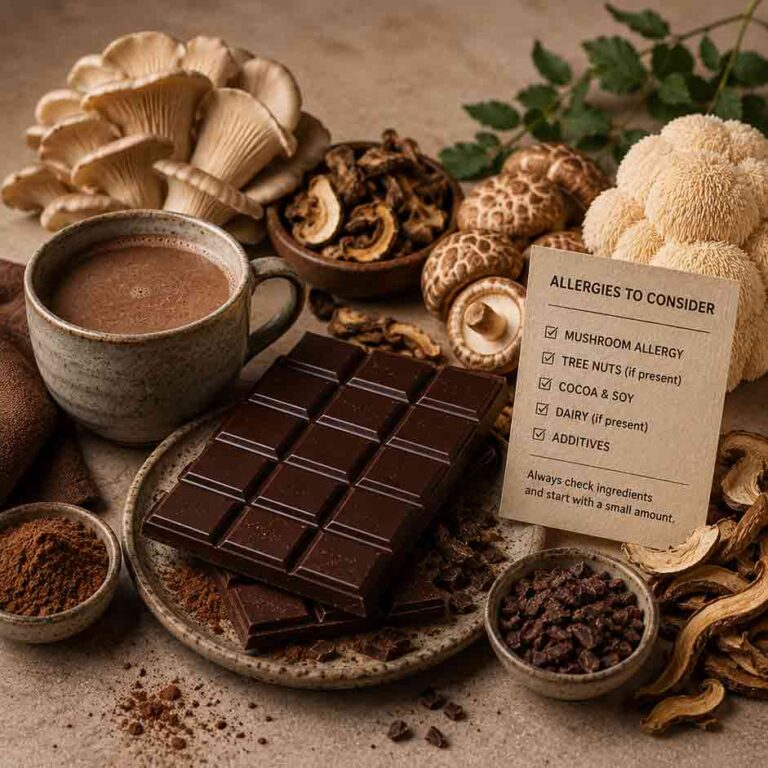
The functional mushroom market has moved well past novelty. What started as a niche supplement category has become a mainstream wellness staple, with the global functional mushroom market valued at approximately $36–40 billion in 2026 and projected to nearly double by 2033. Lion’s Mane, Reishi, Cordyceps, and Chaga are no longer exotic terms reserved for herbalists — they are front-and-center ingredients on the shelves of grocery stores, wellness boutiques, and online supplement shops worldwide.
With that growth has come one very practical question: Which format do you actually choose?
Walk into any wellness store or open any functional mushroom brand’s website today, and you’ll face a binary that looks simple but isn’t: mushroom chocolate bars or mushroom gummies. Both claim the same benefits. Both look appealing. Both fit in your bag. Yet if you’ve tried one and then switched to the other, you’ve likely noticed that something is different — onset time, intensity, convenience, or even how your stomach responds.
This article breaks down the real, practical differences between mushroom chocolate bars and mushroom gummies. Not just the marketing copy, but the actual mechanics: absorption, dosing, ingredients, portability, and which format is likely to serve you better depending on your goals.
What Are Functional Mushroom Edibles, and Why Do They Come in Two Main Formats?
Before comparing formats, it helps to clarify what we mean by “functional mushroom edibles” — because this category covers a wide range of products.
Functional mushrooms are non-psychoactive species like Lion’s Mane, Reishi, Chaga, Cordyceps, and Turkey Tail. Their active compounds — beta-glucans, hericenones, erinacines, triterpenoids, and polysaccharides — are associated with benefits ranging from cognitive support and immune modulation to stress reduction and energy enhancement. A 2024 systematic review in Nutrients analyzed 12 randomized controlled trials and found that Lion’s Mane supplementation at 1–3 grams daily improved cognitive function scores by an average of 15% in adults aged 50–80.
When these mushrooms are infused into consumer products, two delivery formats dominate the market: chocolate bars and gummies. Both carry the mushroom extract, but each format is built on a fundamentally different food matrix — and that matrix affects how the active compounds behave inside your body.
The Core Difference: It Starts With the Matrix
The food matrix isn’t a buzzword. It’s the technical term for the physical and chemical environment in which a nutrient or compound is delivered to the body. It determines how quickly a compound is released, how much of it your system actually absorbs, and how long the effect lasts.
Chocolate as a Delivery Matrix
Chocolate contains natural fats (primarily from cocoa butter), theobromine, and polyphenols. These fats are relevant because many of the active compounds in functional mushrooms — including certain polysaccharides and terpenoids — are partially fat-soluble. The fat content in chocolate can act as a carrier, helping those compounds integrate more efficiently into the digestive process.
Additionally, cacao contains theobromine, a mild stimulant and vasodilator with mood-lifting properties, which may work synergistically with adaptogenic mushrooms. Some users describe the overall experience of mushroom chocolate as feeling more settled and sustained — a perception that aligns with how fat-slowed digestion typically works.
Onset with mushroom chocolate: Approximately 20–30 minutes, depending on individual metabolism and stomach content. The fat matrix slightly delays full absorption but creates a smoother, more extended release window.
Gummies as a Delivery Matrix
Gummies are typically built on a gelatin or pectin base, combined with sweeteners, flavorings, and colorings. The mushroom extract is suspended within this structure. The matrix is water-soluble and breaks down more quickly in the digestive tract than a fat-based chocolate matrix.
However, there’s a nuance: the physical composition of a gummy can create a slower initial breakdown than expected. The gelatin or pectin must dissolve in the stomach before the mushroom extract is fully released. This produces an onset that is, paradoxically, sometimes faster than chocolate — but can also vary widely based on the gummy’s formulation, the density of the base, and whether the product uses hot-process extraction methods that may partially degrade heat-sensitive compounds.
Onset with mushroom gummies: Approximately 30–45 minutes in most reports, though some products with looser formulations may act faster. The release curve tends to be more peaked and shorter in duration than chocolate.
Absorption and Bioavailability: What the Evidence Suggests
This is where the conversation gets less settled — and where critical thinking matters more than marketing claims.
Fat-Solubility Advantages in Chocolate
Many fungal compounds, particularly certain triterpenes found in Reishi and Chaga, are fat-soluble. When delivered via a chocolate matrix rich in cocoa butter, these compounds can dissolve into the fat and be absorbed through the lymphatic system rather than the portal vein — a pathway that bypasses first-pass liver metabolism and can result in higher effective concentrations reaching systemic circulation.
This means that, for fat-soluble mushroom compounds, chocolate is likely a more efficient delivery mechanism than a water-based gummy formulation.
Beta-Glucans and Water-Based Systems
On the other hand, beta-glucans — the primary active polysaccharides associated with immune modulation and many of the most well-studied mushroom health effects — are water-soluble. They do not particularly benefit from a fat-based matrix. For beta-glucan-focused products (like immune-support formulas using Turkey Tail or Reishi), the delivery format may matter less, since these compounds will absorb regardless of the matrix type.
The Gummy Bioavailability Gap
One 2025 analysis by Biology Insights flagged a critical issue: the bioavailability of mushroom compounds within a gummy matrix has not been extensively studied, leaving an open question about whether gummies are an optimal delivery vehicle. Additionally, physical size constraints mean gummies often contain lower concentrations of active extract than equivalent-weight chocolate, especially when fillers, sweeteners, and binders occupy a significant portion of the formulation.
| Factor | Mushroom Chocolate Bar | Mushroom Gummy |
|---|---|---|
| Primary delivery matrix | Cocoa fat + polyphenols | Gelatin or pectin |
| Fat-soluble compound absorption | Higher potential | Lower potential |
| Water-soluble compound absorption | Comparable | Comparable |
| Onset speed (typical) | 20–30 minutes | 30–45 minutes |
| Duration of effect (typical) | 2–4 hours | Shorter peak, ~1.5–3 hours |
| Extract concentration per serving | Generally higher | Often lower due to fillers |
| Bioavailability research status | Suggestive (fat-solubility data) | Limited, not well-studied |
Dosing Precision: Which Format Is More Accurate?
For anyone using functional mushroom edibles with specific wellness intentions — whether that’s a consistent microdosing protocol, daily cognitive support, or structured adaptogen use — dosing accuracy is a real concern.
Chocolate Bars: The Distribution Problem
Mushroom chocolate bars present a distribution challenge. The mushroom extract must be evenly blended throughout the chocolate during manufacturing. When this is done well, each square of the bar contains a consistent dose. When it is done poorly, the extract settles or clumps, meaning some squares contain significantly more active compounds than others.
Premium brands address this with precision manufacturing, scored segments with labeled per-piece dosages, and third-party lab testing. However, lower-quality or artisan-scale producers may produce bars with uneven distribution — which becomes relevant if you’re breaking a bar into pieces to customize your dose.
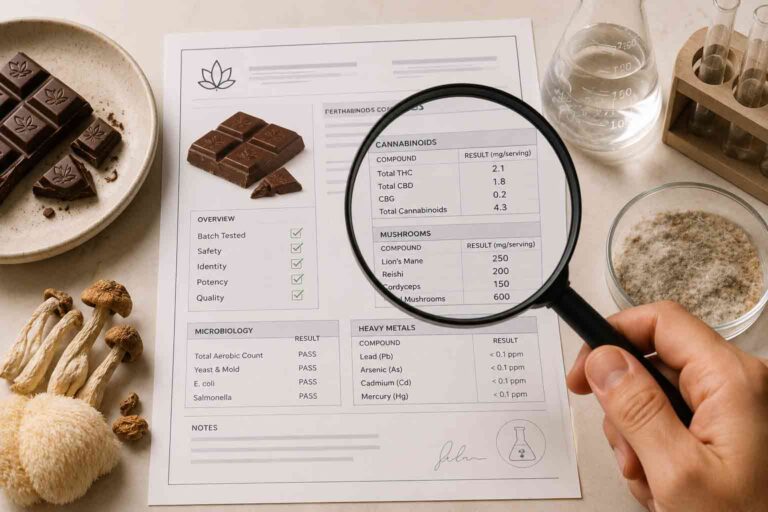
Best practice with bars: Always choose products with scored segments, per-piece milligram labeling, and available Certificates of Analysis (COAs).
Gummies: Per-Unit Standardization
Gummies have an inherent advantage here. Each gummy is manufactured as an individual unit with a defined dose. If a gummy is labeled as containing 500mg of Lion’s Mane extract, each gummy in the bag was produced to that specification. This per-unit standardization makes it easier to adjust dose incrementally — take one gummy for a light day, two for more support.
The caveat is that lower-quality gummies may use inferior extraction methods, meaning the stated milligram amount doesn’t always reflect the actual beta-glucan or active compound content. Third-party testing is equally important here.
| Dosing Factor | Mushroom Chocolate Bar | Mushroom Gummy |
|---|---|---|
| Per-unit standardization | Variable (depends on production) | Consistent by design |
| Dose customization | Adjustable by breaking into segments | Adjustable by unit count |
| Risk of uneven distribution | Moderate with low-quality producers | Low with quality producers |
| Milligram transparency | Improving; best brands label per square | Common; per-gummy labeling standard |
| Recommended verification step | COA + segmented labeling | COA + extract quality certification |
Ingredients: What Else Are You Consuming?
Functional intent aside, both formats come with additional ingredients — and those ingredients matter, especially for daily use.
What Goes Into a Mushroom Chocolate Bar
A quality mushroom chocolate bar contains:
- Cacao or cocoa solids (often 60–80% in premium dark bars)
- Cocoa butter (the fat matrix)
- Sweetener (typically cane sugar, coconut sugar, or a sugar alcohol like erythritol in low-sugar versions)
- Mushroom extract (ideally from fruiting bodies, not mycelium on grain)
- Optional adaptogens (ashwagandha, rhodiola, L-theanine)
- Emulsifier (often sunflower lecithin)
The natural polyphenols in dark chocolate — including flavanols — have documented antioxidant and anti-inflammatory properties of their own, adding an inadvertent wellness layer to the product.
Watch for: Bars that use myceliated grain instead of fruiting body extract. Mycelium-on-grain products contain significant amounts of grain filler and lower concentrations of the active compounds you’re paying for. The U.S. Pharmacopeia published quality monographs for Reishi and Lion’s Mane in 2025, establishing identity, purity, and potency standards that help consumers verify product integrity.
What Goes Into a Mushroom Gummy
A typical mushroom gummy contains:
- Gelatin or pectin (structural base)
- Corn syrup or sugar (texture and sweetness)
- Fruit juice or flavoring (taste)
- Colorings (natural or artificial)
- Mushroom extract (same caveat on fruiting body vs. mycelium)
- Citric acid (preservative and texture agent)
The added sugar is the most significant nutritional consideration. Research cited by Alice Mushrooms notes that gummies can contain up to 8 grams of added sugar per serving — an amount that compounds significantly with daily use, particularly for people already consuming high-sugar diets. For users taking functional mushrooms for metabolic, gut, or energy-related goals, this is worth factoring in.
Vegan and sugar-free gummy options exist — products using pectin instead of gelatin and monk fruit or stevia as sweeteners — but they represent a smaller portion of the market.
| Ingredient Category | Mushroom Chocolate Bar | Mushroom Gummy |
|---|---|---|
| Base material | Cocoa fat | Gelatin or pectin |
| Added sugar (typical) | Low–moderate (dark chocolate) | Higher (up to 8g/serving) |
| Vegan-friendly option | Yes (dark chocolate, no dairy) | Yes (pectin-based) |
| Natural co-benefits | Cacao polyphenols, theobromine | Minimal |
| Artificial additives risk | Lower in premium bars | Higher in budget products |
| Fruiting body vs. mycelium | Varies by brand | Varies by brand |
Portability, Storage, and Real-World Convenience
This is where gummies traditionally win on paper — but the reality is more nuanced.
Temperature Sensitivity
Mushroom chocolate bars melt. This is the unavoidable reality of cocoa butter, which begins to soften around 34°C (93°F) — close to or below ambient temperatures in warm climates or during summer months. A chocolate bar left in a car, a bag in direct sunlight, or a warm gym locker will lose its structure. While potency isn’t necessarily destroyed by mild melting, the dosing becomes unreliable once a segmented bar has re-solidified into an uneven mass.
Gummies are generally more temperature-resistant in moderate heat, though high temperatures can cause them to stick together, degrade the gelatin matrix, or affect texture. For most daily urban or office scenarios, gummies offer more consistent portability.
Discretion and Packaging
Gummies resemble standard supplement gummies or candy, making them highly inconspicuous. A chocolate bar, while widely accepted, requires more deliberate consumption — you’re breaking off pieces of a bar, which draws more attention in a meeting or a gym environment than popping a gummy.
Shelf Life
- Mushroom chocolate bars: Typically 12–24 months when stored properly in a cool, dark, dry environment. The fat matrix provides reasonable preservation for the mushroom extract.
- Mushroom gummies: Comparable shelf life, often 12–18 months, but more sensitive to humidity, which can cause them to absorb moisture and degrade the gelatin structure.
Both formats should be kept away from heat, light, and moisture. Neither requires refrigeration under standard storage conditions.
| Practical Factor | Mushroom Chocolate Bar | Mushroom Gummy |
|---|---|---|
| Temperature sensitivity | Higher (melts above 34°C) | Lower (more stable) |
| Portability in hot climates | Challenging | Better |
| Discretion | Moderate | High |
| Shelf life (proper storage) | 12–24 months | 12–18 months |
| Humidity resistance | Good | Moderate |
| Packaging formats | Single bars, multi-pack | Pouches, jars, single-serve packs |
Taste and the Palatability Factor
Adherence is underrated in the supplement conversation. The most effective product is the one you consistently take — and taste is a driver of consistency.
Mushroom Chocolate Bars
The earthy, slightly bitter flavor of functional mushrooms integrates naturally with dark chocolate. Premium bars use high-quality cacao that complements rather than masks the mushroom profile. Milk chocolate variants offer a gentler, sweeter experience. The sensory ritual of breaking off a square of chocolate carries a satisfying, mindful quality that many users describe as making their daily wellness practice feel like a treat rather than a chore.
The primary limitation is that chocolate is a polarizing flavor for some people, and dairy sensitivities can narrow the available options.
Mushroom Gummies
Gummies are formulated to be broadly appealing — fruity, sweet, and familiar. The mushroom flavor is typically entirely masked, making gummies the easier choice for anyone who finds the earthy taste of mushrooms unpleasant. Flavor variety is wide: blueberry, watermelon, tropical, sour, and more.
The tradeoff is the added sugar and artificial ingredients that come with achieving those flavors in a gummy format.
Who Should Choose Which Format?
The honest answer is that neither format is universally superior. The right choice depends on your specific context, goals, and habits.
Choose Mushroom Chocolate Bars If You:
- Prefer a richer, more indulgent format for your daily wellness ritual
- Want the potential benefit of fat-enhanced absorption for fat-soluble compounds
- Are managing sugar intake and prefer a lower-sugar option
- Take your daily dose at home or in a controlled environment where temperature isn’t a concern
- Value the synergistic contribution of cacao polyphenols and theobromine
- Follow a structured protocol where a slightly longer, smoother onset is preferable
Choose Mushroom Gummies If You:
- Need maximum portability and temperature stability throughout your day
- Dislike the taste of chocolate or earthy flavors and need a fully masked format
- Want per-unit dose standardization without segment-counting or bar-breaking
- Need a format that’s highly discreet in professional or social settings
- Follow a consistent daily supplement regimen and prefer gummies as a familiar format
- Are new to functional mushrooms and want the most accessible entry point
A Third Option Worth Mentioning
Both formats face the same underlying challenge: they’re confectionery formats, not clinical delivery systems. For users focused on therapeutic precision — structured microdosing protocols, consistent adaptogen supplementation, or evidence-based cognitive support — capsules and standardized powders remain the most reliable format, offering exact dosing, no added sugars, and stable shelf life regardless of temperature.
That said, compliance matters. If the most precise capsule sits in a drawer because you forget to take it, a chocolate bar or gummy you actually reach for every day delivers more practical value.
Quality Markers to Look for in Either Format
Regardless of which format you choose, the following quality indicators separate legitimate functional mushroom products from underdosed, mislabeled, or adulterated ones:
- Third-party Certificate of Analysis (COA): Should confirm mushroom identity, beta-glucan content, and absence of contaminants (heavy metals, pesticides, microbial contamination).
- Fruiting body specification: Products using fruiting body extract contain higher concentrations of active compounds than mycelium-on-grain products.
- Clear dosage labeling: Per-piece dosing for chocolate bars, per-gummy dosing for gummies — with milligram amounts for the mushroom extract, not just the total weight of the product.
- Extraction method disclosure: Hot water extraction is standard for beta-glucan-rich products; dual extraction (water + alcohol) is preferred for products targeting fat-soluble triterpenoids.
- No proprietary blend opacity: Any product labeling “mushroom blend — proprietary amounts” without disclosing individual species dosages makes it impossible to evaluate whether the dose is therapeutic.
A regulatory note: The FDA does not pre-approve functional mushroom edibles as supplements or health products. While the U.S. Pharmacopeia published quality monographs for Reishi and Lion’s Mane in 2025, broader regulatory oversight remains limited. The 2024 Diamond Shruumz investigation — in which the FDA investigated illness reports linked to chocolate bars and gummies containing undisclosed compounds — is a reminder that third-party verification is not optional; it is essential.
The Verdict: Is There a Practical Difference?
Yes — though not always in the ways that initial comparisons suggest.
The practical differences that actually matter:
- Absorption: Chocolate has a meaningful advantage for fat-soluble mushroom compounds. For water-soluble beta-glucans, the format difference is minor.
- Dosing reliability: Gummies win on per-unit standardization; chocolate wins on flexibility when scored and properly labeled.
- Sugar content: Chocolate (especially dark) is typically the lower-sugar option.
- Portability: Gummies are more practical in warm conditions and high-mobility scenarios.
- Bioavailability evidence: Neither format has been studied extensively in clinical settings — but fat-solubility science gives chocolate a theoretical edge for certain compound classes.
The format is not a shortcut past quality. A mediocre extract in premium chocolate is still a mediocre extract. A well-dosed, fruiting-body gummy from a transparent brand will outperform a vague “mushroom blend” bar with no COA every time.
Choose the format that fits your life, then choose the best-quality product within that format. That combination is where practical results live.
Key Takeaways
- The global functional mushroom market was valued at approximately $36 billion in 2024 and is on track to reach $67–82 billion by 2033, driven by growing interest in Lion’s Mane, Reishi, Cordyceps, and Chaga.
- Mushroom chocolate bars absorb faster (20–30 minutes onset) due to the fat matrix, which enhances delivery of fat-soluble fungal compounds.
- Mushroom gummies offer better per-unit dosing standardization and superior portability in warm climates, but typically contain more added sugar.
- Neither format has been rigorously studied for bioavailability in clinical settings — quality of extract matters more than format choice.
- Always look for third-party COAs, fruiting body specification, and individual species dosage disclosure regardless of format.
- Capsules remain the most precise format for structured protocols; edibles are best for consistent daily use where palatability drives adherence.
Frequently Asked Questions
Q: Do mushroom chocolate bars work faster than gummies?
Generally, yes. The fat content in chocolate can accelerate absorption of fat-soluble mushroom compounds, with most users reporting onset within 20–30 minutes. Gummies typically take 30–45 minutes as the gelatin base needs more time to break down in the digestive tract.
Q: Which format has more accurate dosing — chocolate bars or gummies?
Gummies have a natural advantage because each piece is manufactured as a standardized unit. Chocolate bars can suffer from uneven extract distribution unless the bar is properly segmented and labeled per square. With either format, always look for third-party lab testing (COA) to verify what’s actually in the product.
Q: Are mushroom gummies higher in sugar than chocolate bars?
Usually, yes. Gummies can contain up to 8 grams of added sugar per serving to achieve their fruity flavor and chewy texture. Dark mushroom chocolate bars — especially those made with 60–80% cacao — typically carry less added sugar and offer the co-benefit of natural cacao polyphenols.
Q: Can I travel with mushroom chocolate bars in warm weather?
It’s risky. Chocolate begins to soften around 34°C (93°F), which makes bars impractical for warm climates, summer travel, or leaving in a car or bag. Gummies are significantly more temperature-stable and the better choice for on-the-go use in heat.
Q: Does the format actually matter, or is the mushroom extract the same either way?
The extract quality matters more than the format — but format is not irrelevant. Chocolate’s fat matrix may improve absorption of fat-soluble fungal compounds like certain triterpenoids. For water-soluble beta-glucans, the difference is minimal. The most important variables are whether the product uses fruiting body extract (not mycelium on grain) and whether it has been third-party tested.
Disclaimer: This article is for informational purposes only and does not constitute medical advice. Functional mushroom products discussed here are non-psychoactive and legal. Always consult a qualified healthcare professional before beginning any new supplement regimen.