The Mushroom Industry Is Booming, But Not Everyone Knows What They Are Doing
The market for mushroom edibles has exploded over the last few years. From functional mushroom gummies to lion’s mane coffee blends and reishi tinctures, consumers are spending billions annually on products that promise everything from sharper focus to better sleep. But here is the real question that most buyers never stop to ask: does the brand behind the product actually understand mushrooms?
That question matters more than most people realize. Mycology expertise is not a marketing badge or a buzzword you sprinkle across a product label. It is a deep, technical discipline that determines whether a mushroom edible brand is producing something genuinely beneficial or simply selling an overpriced, underpowered product dressed up in earthy packaging.
This article breaks down what real mycology expertise looks like inside a mushroom edible brand, why it separates the industry leaders from the opportunists, and how consumers and retailers can tell the difference.
What Is Mycology, and Why Does It Matter for Edible Brands?
Mycology is the scientific study of fungi, including their genetics, biochemistry, physiology, ecology, and taxonomy. It is a complex field that intersects with pharmacology, agriculture, food science, and immunology. When a mushroom edible brand claims mycology expertise, they are claiming mastery over a discipline that takes researchers and cultivators years, sometimes decades, to develop.
In the context of an edible brand, mycology expertise means understanding how a mushroom grows, what compounds it produces, under what conditions those compounds are optimized, how extraction methods affect bioavailability, and how the final product delivers value to the human body. That is a lot of ground to cover, and most brands cover very little of it.
The tragedy of the current mushroom edible space is that many brands outsource all of this knowledge. They buy bulk mycelium powder from a contract manufacturer, slap a logo on it, write a few claims about adaptogens, and call themselves mushroom experts. Real mycology expertise looks nothing like this.
Growing Conditions and Substrate Knowledge
Why the Growing Medium Changes Everything
One of the first places you can spot real mycology expertise is in how a brand talks about its substrate, the material on which mushrooms are grown. Different mushrooms thrive on different substrates. Lion’s mane grows beautifully on hardwood. Reishi prefers oak logs or sawdust. Oyster mushrooms can colonize straw. A brand that understands mycology knows that the substrate is not just a growing medium; it is actively part of the final biochemical profile of the mushroom.
When a brand sources or produces mushrooms grown on grain, particularly oats or brown rice, the resulting product contains significantly more starch from the grain and fewer of the actual fungal compounds that consumers are paying for. This is the mycelium on grain problem that has plagued the North American supplement industry for years. A truly expert brand knows this, avoids it, and explains it to their customers without being asked.
Fruiting Body vs. Mycelium: A Foundational Distinction
Perhaps no knowledge gap reveals a lack of mycology expertise faster than confusion between fruiting bodies and mycelium. The fruiting body is the actual mushroom, the part that emerges above the surface and contains the highest concentrations of beta glucans, triterpenes, and other bioactive compounds. Mycelium is the root network, and while it plays an important biological role, products made primarily from mycelium (especially mycelium cultured on grain) tend to have far lower concentrations of the compounds consumers are seeking.
A brand with real mycology expertise will clearly specify which part of the fungus they are using, at what concentration, and why. They will not hide behind vague language like “whole mushroom blend” when the reality is that they are using myceliated grain powder.
Extraction Science and Bioavailability
Hot Water vs. Dual Extraction: Knowing the Difference
Not all mushroom compounds are extracted the same way. Beta glucans, the primary immune modulating polysaccharides found in medicinal mushrooms, are water soluble. A hot water extraction is sufficient to pull them from the mushroom tissue. However, triterpenes, the compounds responsible for many of the adaptogenic and anti inflammatory properties of mushrooms like reishi and chaga, are fat soluble. They require alcohol extraction to be made bioavailable.
A brand with genuine mycology expertise understands this chemistry deeply. They know when a single extraction is appropriate and when a dual extraction (combining hot water and alcohol extraction) is necessary to deliver the full spectrum of a mushroom’s bioactive compounds. They can explain their extraction ratios, their solvent selection, and their quality control processes clearly and without hesitation.
Brands that lack this expertise tend to produce simple capsules filled with dried mushroom powder that has not been extracted at all. While whole mushroom powder has some value, it is dramatically less bioavailable than a properly extracted product, and a real expert will tell you that.
Standardization and Lab Testing
Standardizing to beta glucan content is one of the clearest markers of mycology and quality assurance expertise in the edible space. It means that every batch of product is tested to confirm that it contains a specific, meaningful percentage of the active compounds. This is common practice in the pharmaceutical and botanical supplement industries, but it is still rare in the mushroom edible market.
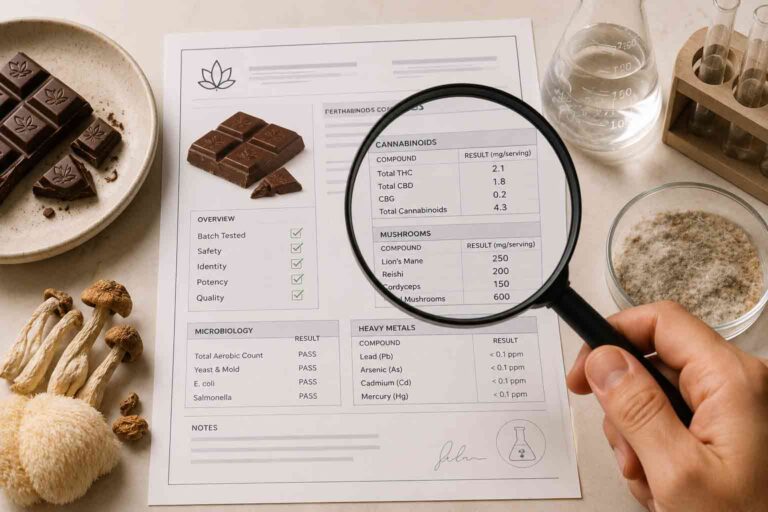
A brand with real expertise will have certificates of analysis (COAs) readily available, will test for heavy metals, pesticides, microbial contamination, and mycotoxins, and will standardize their active compounds so that consumers are getting a consistent, effective dose in every product they buy.
Species Identification and Sourcing Integrity
The Problem With Misidentified Mushrooms
Accurate species identification is a core skill in mycology, and it has direct implications for consumer safety and product efficacy. There are thousands of fungal species in the world, and many of them look remarkably similar to one another. In the wild crafting and foraging space, misidentification can be genuinely dangerous. In a commercial edible brand context, it can mean that consumers are paying for lion’s mane but receiving a less expensive or less effective substitute.
A brand with real mycology expertise works with taxonomically verified strains. They can name the specific species they use with its full Latin binomial, and they can trace that strain back to a certified source. They do not vaguely refer to “lion’s mane mushroom” without being able to confirm they are working with Hericium erinaceus and not a related but distinct species.
Sourcing Transparency and Supply Chain Knowledge
Knowing where your mushrooms come from is not just an ethical concern; it is a quality concern. China remains the world’s largest producer of medicinal mushrooms, and many high quality mushrooms do come from Chinese suppliers with decades of cultivation expertise. However, the quality varies enormously depending on the specific supplier, growing region, processing method, and testing protocols.
A brand with genuine mycology expertise has done the work to vet their suppliers. They have visited farms, reviewed growing practices, insisted on third party testing, and built relationships with cultivators who share their commitment to quality. They are not simply clicking “buy” on an Alibaba listing and repackaging the result.
Formulation Intelligence: Knowing How Mushrooms Interact With Other Ingredients
Synergistic Stacking and Antagonistic Combinations
One of the more sophisticated expressions of mycology expertise in product formulation is understanding how mushrooms interact with other botanicals, vitamins, and compounds. For example, lion’s mane is often combined with bacopa monnieri or phosphatidylserine for cognitive support because the mechanisms of action are complementary. Reishi pairs well with ashwagandha because both work along the HPA axis to modulate stress response.
But some combinations do not make as much sense as they appear on a label. A brand that simply piles ten mushroom species and fifteen adaptogens into a single capsule without understanding dosing thresholds, compound interactions, or bioavailability windows is not demonstrating expertise. It is demonstrating marketing enthusiasm. A truly expert brand designs formulas with intention, at clinically meaningful doses, based on published research and a real understanding of the compounds involved.
Appropriate Dosing and Clinical Relevance
Dosing matters enormously in the mushroom edible space, and it is where a lot of brands quietly fail. It is easy to include lion’s mane in a product at 50 milligrams and then market the product as a cognitive enhancer. The problem is that most of the research supporting lion’s mane’s neuroprotective and NGF stimulating properties uses doses of 500 to 3000 milligrams per day. A product dosed at 50 milligrams is not going to deliver those benefits, regardless of how beautifully the packaging is designed.
A brand with real mycology and formulation expertise prices their products accordingly to support effective doses. They do not underdose to keep costs low. They understand that a product needs to work to earn repeat customers, and working requires dosing that aligns with the evidence.
The Role of Scientific Literacy in Brand Leadership
Founders and Formulators Who Understand the Research
Real mycology expertise at a brand level often starts with the people who built the brand. A company founded by a trained mycologist, a naturopathic doctor, an ethnobotanist, or a food scientist with a fungi specialization is starting from a fundamentally different knowledge base than a company founded by a wellness entrepreneur who discovered mushrooms two years ago.
This does not mean that founders without formal training cannot build expert brands. But it does mean that the formulation team, the sourcing relationships, and the quality control processes need to be informed by real expertise, whether that comes from the founders themselves or from the scientists and mycologists they hire.
Scientific literacy at the leadership level means the brand is reading the peer reviewed literature, not just the wellness blogs. It means they can evaluate a new study critically rather than simply celebrating any research that supports their product narrative. It means they update their formulas and their claims when the evidence evolves.
How Mycology Expertise Shows Up in Brand Communication
Transparent, Precise, and Honest Labeling
One of the simplest ways to assess whether a mushroom edible brand has real mycology expertise is to read their labels and their website copy carefully. Expert brands are precise. They tell you the species. They tell you the part of the mushroom used. They tell you the extraction method. They tell you the standardization percentage. They tell you the dose per serving.
Non expert brands are vague. They use the word “mushroom blend” without specifics. They mention “the power of fungi” without explaining how or why. They list a dozen species at doses too small to matter. This vagueness is not humility; it is a signal that there is not much substance behind the branding.
Education as a Brand Value
Brands that genuinely know their subject tend to teach. They publish detailed blog posts, host podcasts, collaborate with researchers, and create content that helps consumers understand what they are buying and why. Educational content is one of the clearest signals of real expertise, because you can only teach what you actually know.
If a brand’s entire content library is aspirational lifestyle photography and vague wellness claims, that tells you something important about how deep their knowledge actually goes. If their content includes deep dives on beta glucan extraction ratios, the difference between Hericium erinaceus and Hericium americanum, or the current state of clinical trials on psilocybin adjacent compounds, that tells you something very different.
Why This Matters for Consumers, Retailers, and the Industry
The mushroom edible industry has enormous potential to contribute meaningfully to human health. The science supporting functional mushrooms is real, growing, and genuinely exciting. Compounds like hericenones and erinacines in lion’s mane, ganoderic acids in reishi, and ergothioneine across multiple species represent a frontier of natural medicine that deserves serious attention and serious products.
But that potential is undermined every time an underdosed, poorly extracted, or misbranded product reaches a consumer and fails to deliver. It erodes trust in the category, discourages repeat purchases, and hands ammunition to skeptics who want to dismiss functional mushrooms as nothing more than wellness theater.
This is why mycology expertise is not a niche concern. It is the foundation of a functional mushroom edible brand’s credibility, efficacy, and long term viability. Consumers who learn to ask the right questions, and retailers who choose brands that can answer them, are actively shaping an industry toward higher standards.
Conclusion
Mycology expertise in the context of a mushroom edible brand means far more than a passion for fungi or a forest foraging background. It means substrate knowledge, species verification, extraction science, clinical dosing, supply chain transparency, formulation intelligence, and a commitment to honest communication. It means the brand has done the hard work, not just the branding work.
As the market matures, the gap between genuinely expert brands and marketing driven imitators will become increasingly visible. Consumers are getting smarter, third party testing is becoming more accessible, and the science is becoming more specific. The brands that survive and lead will be the ones that earned the word expertise rather than simply borrowed it. When you choose a mushroom edible brand, choose one that can show you the work.
Frequently Asked Questions
Q1: What is the difference between fruiting body and mycelium in mushroom supplements?
The fruiting body is the actual mushroom cap and stem, which contains the highest concentration of beneficial compounds like beta glucans. Mycelium is the root network, and when grown on grain, it delivers far fewer active compounds per serving.
Q2: Why does extraction method matter in mushroom edible products?
Different mushroom compounds require different extraction methods to become bioavailable. Beta glucans need hot water extraction, while fat soluble triterpenes require alcohol. A dual extraction ensures you get the full spectrum of a mushroom’s active compounds.
Q3: How can I tell if a mushroom brand has real mycology expertise?
Look for clear labeling that specifies the mushroom species, plant part used, extraction method, standardized beta glucan percentage, and third party certificates of analysis. Vague language like “mushroom blend” is a red flag.
Q4: Does the dose of mushroom extract actually matter?
Absolutely. Many brands include popular mushrooms like lion’s mane at doses far too low to produce any real effect. Research supporting cognitive benefits typically uses 500 to 3000 milligrams daily, so always check the amount per serving before purchasing.
Q5: Are mushrooms sourced from China lower quality?
Not necessarily. China is the world’s largest and most experienced medicinal mushroom producer. Quality depends on the specific supplier, cultivation practices, and testing standards, not the country of origin alone. A reputable brand will vet and verify their suppliers regardless of location.